
Assembly of Ranque-Hilsch Effect Tube
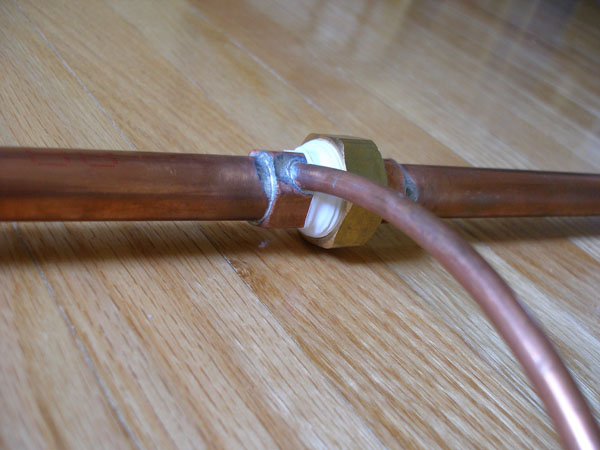
Let's start at the hardest part. The most difficult part was making the vortex chamber itself because it involved drilling into the re-makeable coupling at an angle. I used a drill press and put the coupling into a vice. I used a cobalt-nitride drill bit - which is extremely hard - but I think that part was overkill. I just slowly lowered the drill bit down and it made it through just fine. At the time, I didn't have the camera with me, so I have to show the vortex chamber with the copper tubing already soldered into it. By this time, I had already tested it, so that's remnants of Teflon tape you see. This piece of the re-makeable coupling was soldered to one end of the 1 m length of copper piping. Incidentally, you can see a ring indentation where the washer was pressed into the inner surface of the coupling. Also, you can see that the end of the copper tubing has been ground with a bench grinder so that it is shaped to ensure no tubing obstructs air flow around the chamber.
As you can see above, that's the half of the re-makeable coupling with the hex sides (for wrenches). If I drilled the other (round) side, I would run into trouble when I soldered-in my copper tubing, because if you look at the pictures of the coupling on the Parts List Page, you can see that you need to be able to unscrew the threaded collar and pull it out over the round side to separate the coupling.




P. David Buchan pdbuchan@yahoo.com